
If you watch yourself talking in length about pending bills, insurance coverage updates and limited savings every month, you need to read this. Having a healthy relationship with money is important to remain debt-free and achieve goals.
It requires commitment to ensure disciplined finances. Your finances might be drowning in the deep sea now. However, you must act to save the future from sinking. The blog lists some ways to improve your relationship with money.
|
Are savings important? |
Yes! They are |
|
Can money buy happiness? |
Yes, until you start earning above £75k! |
|
How much money do you need to save to be happy? |
£30000-£37000 annually to be happy in the UK |
|
Save or invest? |
Investing is a better way to grow money |
Can Money buy happiness?
Yes, money may help you buy happiness as it helps you remain stress-free, frees up time for relationships and holidays and grants more opportunities for shared experiences. Dining and travelling with friends and family, and improving your social media feed, surely improve the mood.
Precisely, it helps you accomplish other desires comfortably apart from meeting the basic needs. However, if earning £75-£100k a year, the impact lessens. It then depends more on how you spend the money on shared experiences rather than just accumulating wealth.
How much money do you need to be happy?
According to recent statistics, “you need £30000-£37000 annually to be happy in the UK.” However, this may vary according to the city you live in. For example, living in London is costly in comparison to other cities. Moreover, the plateau of happiness continues to rise after you start earning £54000 yearly. It highlights comfort and reduces stress. It is because physical and mental well-being is the goal.
|
Age Range |
Average Cash Savings (Actual) in pounds |
Recommended savings target |
|
18-24 |
£4,759 average savings |
At least one emergency fund covering 3-6 months of essential expenses. It means actual savings should be around(£7000-£15000) |
|
25-34 |
~£9,357 average savings |
1× annual salary total savings by age 30 (it includes pensions/ISAs) suggested by planners |
|
35-44 |
£7,434 average savings |
2× annual salary total savings by age 40 (pensions + investments) |
|
45-54 |
~£13,318 average savings |
3–4× annual salary total savings by age 50 (target is higher with investment/pension) |
|
55+ |
£27,949 average savings |
6–8× annual salary total savings by age 60 (retirement focus) |
This is how the actual saving curve should look. However, it becomes challenging to save enough after 55 or when you retire from the job. At the same time, the fragile body demands extra care. You need to ensure regular health checkups and important surgeries if due.
Thus, if you are old enough or over 70 and cannot attain the saving goal (6–8× of the annual salary), check loans for people over 70 in the UK marketplace. It may help you fund big surgeries and other medical requirements if you lack insurance. The repayment and approval depend on earnings from pension and other legal investments.
How to improve your relationship with money?
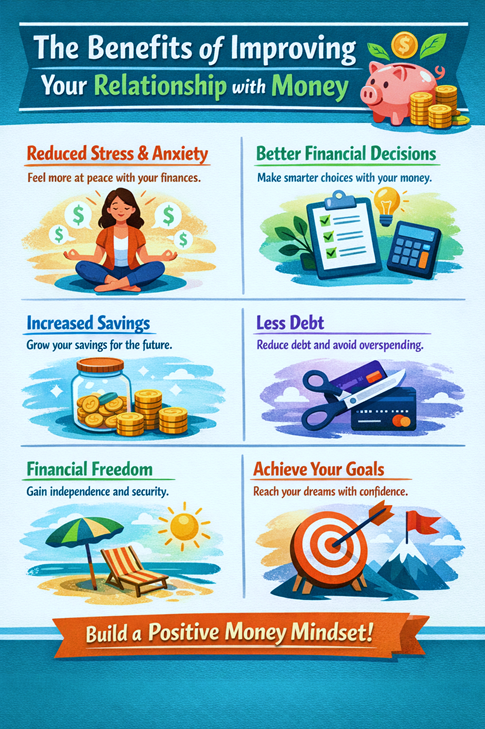
If you want to reach your retirement savings goal or remain debt-free, here are ways to improve your relationship with money:
1. Create a budget according to your values
A budget should reflect what you value, not restrict you. You can try the 50/30/20 module to start saving.
- 50- needs (utility bills, rent, groceries, mobile recharge)
- 30- wants (dining out, movie, shopping)
- 20- savings (emergency, investments)
Why does this matter? Allocating money according to what matters the most for you makes budgeting stress-free.
2. Address financial beliefs and emotions
Your habits, upbringing, money priorities, culture and past experiences define one’s financial behaviour. Thus, you must address your emotions and say, “Yes, I’m bad at managing money”.
However, “I must improve and spend money to be happy”. Yes, Acceptance is the key here. Try to replace the vague beliefs like- “ I must spend now and will save later” by “I will try to save a minimal amount monthly.”
Why does this matter? Emotional triggers often drive unplanned spending or avoid financial distress.
3. Build and maintain an emergency fund
An emergency fund is a savings account exclusively for the critical cashless times. It helps you meet essentials during unemployment, disability, and serious accidents. You generally need to have 6 months of savings to sustain the basic requirements. This buffer helps avoid debt and provides peace of mind.
Why does this matter? Financial shocks are stressful and lead to panic. Not meeting goals in a timely manner may affect mental and financial well-being. Therefore, having an emergency fund eradicates such possibilities. It instead helps you meet the needs instantly.
However, in the absence of it, you cannot wait until you get the part-time pay. Instead, check a no guarantor loan for a bad credit score for your needs. It may help you get the needed funds without involving a third person. It grants full control over the payments and bills. You can choose a repayment structure that goes along with your basic minimum lifestyle. It helps you avoid loan default.
4. Track spending with intention
Understanding what you spend in a month is important. It helps you identify the discretionary expenses and control them. Instead, you can use the money for a better use, like towards the mortgage deposit if you plan to buy a house.
You can also use budgeting and expense tracking tools like Monzo and Starling, and categorise spending according to priorities. Focus on the most important expense first and then the least important one. Next, review your finances and expenses monthly. It will help you make the necessary changes.
Why does this matter? Tracking your every expense reduces impulse spending. It instead highlights the opportunities to relocate the money towards other priorities. It may include debt repayment or retirement planning.
5. Practice mindful spending
It is important to understand the requirement before shelling out a dime. Identify and ask yourself a few questions.
- Would you use it for at least 6 months?
- What purpose does it serve?
- Will buying it affect my other important bills?
Analysing such aspects would delay the purchase. But it is for your better as it helps avoid unnecessary expenses.
Why does this matter? Habitual and emotional spending may erode your financial stability. It may not improve your financial well-being.
Bottom line
These are some of the best ways to improve your relationship with money. It may help you identify whether you should or not invest in a particular thing. Try to develop a budget and save money accordingly. It will help you focus on the aspect that matters. It may include meeting essential payments, clearing debt and preparing for retirement.

Emma Anderson is a financial advisor at Quickloanslender who always believes in researching hard to know her clients’ financial problems. She takes the time to understand their financial wants and needs to write the blogs on them as the solutions. In her long 14 years of experience, she has written plenty of blogs on the financial and business sectors of the UK.
Emma Anderson has been recognised for her work in financial planning and her blogs are regularly published in the website of Quickloanslender. As far as her educational qualification is concerned, she has done Masters in Accounting and Finance, and done PG Diploma in Creative Writing.